
What Xi-Trump means for Europe
The worst-case scenarios didn't materialize. But the shifting US-China power balance that was on stark display in Beijing confronts Europe with tough choices.

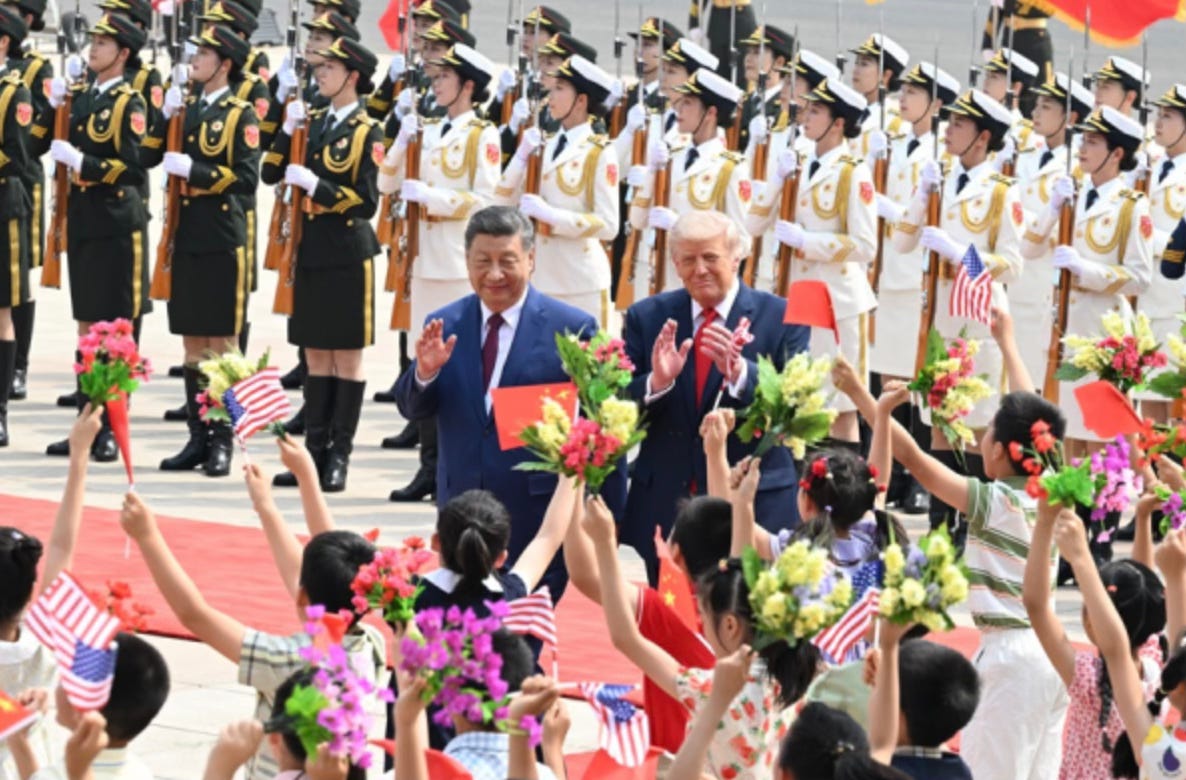
For months, European officials have been agonizing over Donald Trump’s summit with Xi Jinping. Their anxiety centered around three main scenarios. First, there was concern that the US and Chinese presidents would seal a grand bargain on trade that would leave the EU out in the cold. Second, there was a fear that Trump would throw Taiwan under the bus in exchange for promises of Chinese help with Iran – either by agreeing to halt US arms sales to the island or by tweaking US language on Taiwanese independence. Lastly, some European capitals saw a risk that Trump would agree to send more advanced chips to China, even as Washington ramps up pressure on Europe to rein in sales of the Dutch-made lithography machines needed to produce those chips.
In the end, none of these scenarios came to pass. There was no grand trade bargain – just a vague pledge to create a Board of Trade that would manage, in the words of Treasury Secretary Scott Bessent, trade in fireworks and other non-sensitive goods. Taiwan, based on the public statements that are available, emerged unscathed, though everyone will be watching to see whether the US arms package gets a green light from Trump now that the visit is behind him. And there were no signs of a further loosening of US chip controls, despite the last-minute addition of Nvidia’s Jensen Huang to the US delegation. Europe can breathe a little easier. And yet, the Trump-Xi meeting was still unsettling for Europe on a number of counts. Let me explain why.
US Decline
First, the shifting balance of power between the United States and China was on stark display. This shift has been evident ever since China hit back at Trump’s “Liberation Day” tariffs a year ago with rare earth controls that sent the US and many of its partners into panic mode. But watching Trump and Xi in action over two days of carefully orchestrated events in Beijing made it excruciatingly palpable. While Trump lauded his Chinese counterpart as a “friend” and “great leader”, Xi spoke to Trump about US decline and gave him a stern lecture about the risks of crossing Chinese red lines on Taiwan. Trump assured Fox News that Xi was eager to help with Iran. But in the end, the Chinese leader offered him nothing concrete on the issue he cares about most.
The visit ended with big questions about whether the US will be able to build back the tariffs it imposed on China last year, before US courts ruled many of them illegal. China has promised to retaliate if Washington imposes new Section 301 tariffs to fill the gap. It may also consider them a violation of the trade truce reached between Trump and Xi in Busan, South Korea last year – raising the prospect of more debilitating Chinese restrictions on critical minerals. US Trade Representative Jamieson Greer was cagey in an interview with Bloomberg when asked about how the US would proceed. The bombast of “Liberation Day” has vanished, replaced by studied restraint with Beijing.
China Tariffs
Take all this, together with the tariff reductions on $30 billion in non-sensitive trade with China that the administration says it is considering as part of a new “Board of Trade” with Beijing, and one can come up with a scenario where US tariffs on China end up lower than they were when Trump took office last January – and below the levels that Europe and other traditional US allies have agreed to pay. If we end up here, it would be a damning sign of US impotence when it comes to trade with China - much of it self-inflicted. That would not good for Europe – especially at a time when the European Commission, as I revealed in this newsletter earlier this month, is preparing to ask EU member states for a green light to hit China with more forceful trade measures.
This would include the deployment of safeguards across a range of new sectors, including chemicals and machinery, and the development of a new instrument designed to shield Europe from an avalanche of cheap Chinese exports. Rallying European countries behind a trade war with China at a time when the US is beating a hasty retreat from one will be a mammoth challenge. No, the Xi-Trump meeting was not the transactional love-in that some in Europe feared. But neither did it show that the Trump administration has the stomach for the kind of confrontation with Beijing that Europe is now contemplating..
Time to Fold
This leads me to my second point. Beijing will emerge from the Trump visit feeling more confident about its leverage and emboldened to press ahead with its current confrontational course. This too, will be a problem for Europe, which has found itself on the receiving end of an endless stream of threats from Beijing in recent weeks. These have included robust responses to the EU’s Industrial Accelerator Act (IAA) and Cybersecurity Act (CSA), the sanctioning of European firms for providing dual-use technologies to Taiwan, and what one French diplomat who recently travelled to China described as “very harsh” warnings about Beijing’s readiness to retaliate. “Their message is: the Americans are folding. Now it’s time for you to fold,” the diplomat said.
On Friday, China’s Ministry of Commerce issued a statement declaring that the European Commission’s ongoing investigation of Chinese airport scanner company Nuctech, via its Foreign Subsidies Regulation (FSR), amounted to “improper extraterritorial jurisdiction”. This is the first application by China of a State Council decree issued last month and heralds an escalation in China’s pushback against EU measures like the FSR, IAA and CSA. We can expect more of this in the months to come if the Commission gets a mandate to hit back hard with safeguards.
Home Alone
Lastly, the Trump-Xi summit has underscored just how alone the EU now is when it comes to responding to China. The US will not be pushing Europe to act in a certain way or take specific measures against China, as it did under Biden and at the tail end of Trump’s first term. Trump may decide at some point in the future to give more space to the China hawks in his administration, at the expense of stability in the relationship, but we are probably quite far from that point. That leaves Europe in a tough spot.
In the short term, I expect member states to dial up the pressure on the European Commission to reconsider its refusal to host an EU-China summit this year unless Xi Jinping shows up. Chinese officials have been privately sending the message in recent weeks that Premier Li Qiang is prepared to come. “We would like to see that summit happen,” the French diplomat said. “If we insist on Xi we are saying no to dialogue with China. That would be a mistake.”